
In 1991 Spike Lee released ‘Jungle Fever’, a movie about an interracial couple. When it came out, it was making the news, but I only remember it because my brother looked at me and said, “What’s the big deal?”
I shrugged, “I have no idea.” Fast forward to 2019, he sent me a New York Times article titled, Want to be Less Racist? Move to Hawaii.
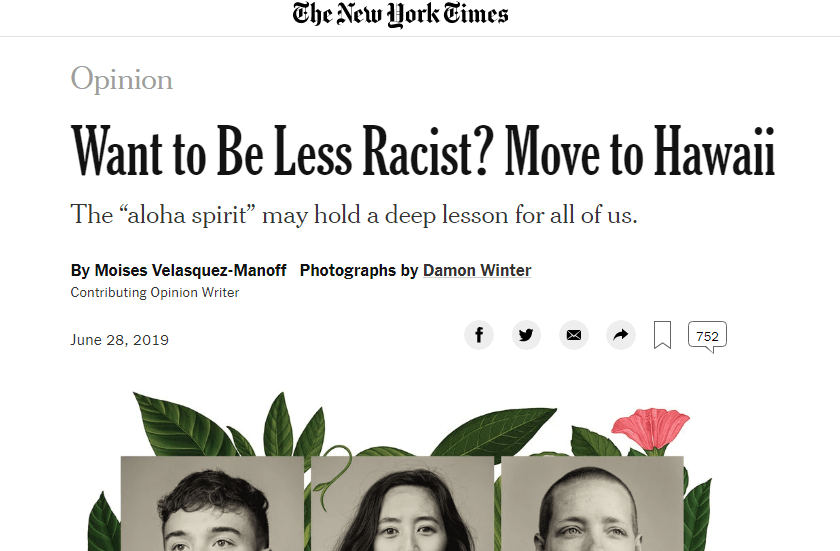
Now, I know Hawaii’s diverse, so I figured the piece had something to do with that. Larry warned me that the write-up was long, but that the photos were worth seeing. Curious, I headed over to NYT and read the entire thing.
Hawaii had the highest percentage of mixed-race people by a long shot in the country.
I remember returning to Hawaii after my college years in small-town Durango, Colorado. There were a couple of observations I made during my travels. First, the airline passengers got whiter the further east I traveled. Second, as I was sitting on the bus, I appreciated for the first time the incredible amount of diversity I was among. I recall thinking, “There’s probably more diversity in this bus than the entire state of Colorado.”
Probably an exaggeration. Probably.
The article follows Dr. Pauker’s studies on race in Hawaii. While there is a lot I could remark on, I’ve decided to focus on two points because they validated how I’ve been talking/thinking about race for years – and now I have science-based observations to back me up. Woo-hoo!
An intriguing finding from Dr. Pauker’s lab is that kids in Hawaii are terrible at defining other people’s race compared with kids on the mainland. That’s not because they don’t see the features usually associated with race. It’s because, when shown photos, they complicate their answers. Whereas a kid on the mainland might simply say “Asian,” in Hawaii, kids tend to say something like, “Japanese, Chinese, Filipino and Norwegian.” Instead of labeling a face “white” and leaving it at that, they might offer “Scottish, Irish, German and Italian.” They are like fine wine connoisseurs while everyone else drinks cheap beer. From an early age, they see race as something complex and full of nuance, not something simple or black and white.
When I moved away from home and folks asked me, “What are you?” I wasn’t offended. Everyone in Hawaii freely talks about race.
But I was offended when they yelled fake Chinese at me from the safety of their moving vehicles. I was offended when they walked up to me and said, “Konnichi wa”. And I was offended when they called me beef and broccoli and other Chinese dishes as I returned to my apartment.
But I was confused when I asked them the same question, and they responded, “I don’t know.”
“You don’t know!? What do you mean, you don’t know?”
“Oh, I’m probably Irish and Scottish. I’m probably a mix, a mutt, not like you.”
My confusion deepened because I would have already answered, “Chinese, Thai, and a little bit of Russian.”
Many people thought that I was Hawaiian because I was born and raised in Hawaii. Then I quickly figured out an analogy, “I’m not Native Hawaiian, just because you were born in America does not make you’re Native American.” Decades later though, my brother would get DNA testing and we’d discover we’re 6-8% Polynesian, too.
—
When I worked in predominately white places, like Portland Oregon, I’d “discover” my mixed-race colleagues.
“What are you?”
“What do you mean?”
“You look mixed, hapa. What’s your ethnicity?”
“Oh, I’ve got some Cherokee on my father’s side.”
OR
“I’m half Peruvian.”
“Really? Cool. Do you speak Spanish?”
OR
“My mom’s from Indonesia.”
“Yeah, that’s it. I can see it.”
—
Hawaii is not a politically correct society where everyone is “woke.” On the contrary, ethnic jokes are so common it can be jarring for people who aren’t from Hawaii. (Here’s one from the well-known Hawaiian-born comedian Frank De Lima, who himself has Portuguese ancestry: “Why did the Portagee water half of his lawn? He heard there was a 50 percent chance of rain.”)
This is 100% accurate. I grew up listening to racist jokes and told some good ones as well. In the above example, you might notice it’s the Portuguese that’s on the receiving end of these jokes. But I believe the key distinction here is EVERYBODY gets trashed.
In kindergarten, I apparently came home in tears because someone called me chop suey. I say apparently because my mom had to remind me of the incident. In Hawaii, white people are called haole and it is up for debate whether this term is descriptive or derogatory.
My stepdad was beaten by Filipinos on his first day of a new job for being white. A fellow grad student opened up about being bullied throughout her childhood because of her whiteness. Her tears silenced the room, but then sparked a conversation about race and diversity in Hawaii.
My high school friend, who is half black and Japanese, told us about how she was getting picked on one day, but she avoided the fight by reciting her Shakespeare lines (we were putting on Romeo and Juliet) with great volume and enthusiasm; thereby disturbing and confusing her tormentors.
I didn’t realize how lucky I was to grow up in Hawaii until I left. Funnily, it was the reactions of other people that created this impression in me. And now as racial tensions consume the Western world, I’m reminded that Hawaii has given me another gift, an outsider’s perspective in an escalating climate of us versus them.
If we could begin to grasp the limits of the planet we live on, if we could understand that the earth itself is an island and that we are all dependent on one another for survival, perhaps we would see each other differently, too — and have less use for the very idea of race.









 Life, the Universe, and Lani
Leave a reply to bloominginjapan Cancel reply