
When I first started working in Thailand back in 2010, I remember listening to a casual debate among my fellow teachers whether or not the Thai diet was a healthy one. Upon first glance it certainly appears so, as meals were smaller (farangs would joke about ordering two plates of food), and the people were generally petite and thin.
But another teacher exclaimed that everything is deep fried, and sugar is tossed into foods as generously as road rules are ignored. I grew up watching my (Thai) mom cook, and she’d tablespoon sugar into stir-frys and other dishes that Westerners would consider sugar-free. But both my former colleagues are correct, and I think this is why folks both foreign and local don’t see how much the Thai diet has changed – and not for the better.

A quick overview
In 2013, Forbes published an article on how Thais stay thin eating all day. Month-long visitor, Elisa observed the smaller portions of meat, and absence of Western sweets like cakes and brownies. And while she mentions bone structure or “good genes”, she praises the Thai diet for it’s healthy snacks like sliced green mango or roasted bananas, and generally avoiding fast food.
Yet as early as 2002, a researcher from the Institute of Nutrition at Mahidol University published a paper that would have sent many people into a state of sugar-induced shock.
• “Thai staples and side dishes are being replaced by diets containing a higher proportion of fats and animal meat.
• More consumption of ready-to-eat food, in both rural and urban settings.
• The prevalence of overweight and obesity among children and adolescents has increased dramatically during the past 20 years.
• Among adults, results from two national surveys in 1991 and 1996 indicated that the problem of overweight and other risk factors for cardiovascular disease have increased significantly.” [emphasis mine]

What I’ve noticed
I’ve been living in Thailand off-and-on for the past ten years in cities like Chiang Mai, Chiang Rai, and now Rayong. Teaching here and returning from other countries has allowed me to observe the population, specifically, my students who are typically teenagers or young adults. I’ve been able to watch the student body grow both taller and fatter. Many teens now have very bad acne, whereas in the past this was not the case. And of course, I’ve witnessed how they eat because they often snack during class breaks.
It’s common to see my students with deep fried meats, and convenient snacks from 7-11. Now, all teenagers love junk food. I was no exception, but what’s interesting is how abundant these kinds of foods are available for them.
If you happen to walk by any school at the end of the day, you’ll see street vendors lined up. What they often sell is:
• deep fried processed meats with a spicy or sweet chili sauce
• Mama (the local brand of instant) noodles
• powdered/instant drinks and sodas
• french fries (sometimes with a cheese sauce of an unnatural color)
• fried chicken, fried chicken, fried chicken
* there might be one fruit seller among the vats of bubbling oil
If the kids go to 7-11 during their break/snack times, they get:
• microwaved foods such as burgers, rice dishes, and cheesy lasagna
• processed toasted sandwiches
• chips or other bagged snacks like dried squid strips
• sugary drinks from chocolate milk to soda to teas
• ice cream
*and it should be noted that they often buy several of these items at once
I used to visit my great aunt who was one of those school-side vendors. One day I watched her making curry (the kind with the chunks of blood). My eyes widened when I saw her cut open a generous bag of MSG and pour all of it in. To be fair, it was a big batch she was making. To be not fair, did all of it need to go in? Regardless of whether or not you think MSG is bad for you or not, it was a lot of flavor enhancer. And this is coming from the gal (me) who loves her some table salt.
Sure, sushi is also popular, as are papaya salads. Occasionally, there will be a student eating fried bugs. But you’d be amazed at the lack of fresh fruits and vegetables in these kids’ diets. It’s not uncommon to hear that students declare they hate bananas. I guess because it’s so abundant here. Thais love KFC, too. The idea that Thais don’t eat fast food like McDonalds (as mentioned in the Forbes article) is desperately outdated as the country has become more industrialized over the decades.
Hopefully, they eat better at home.
Sugar, but it tastes so good
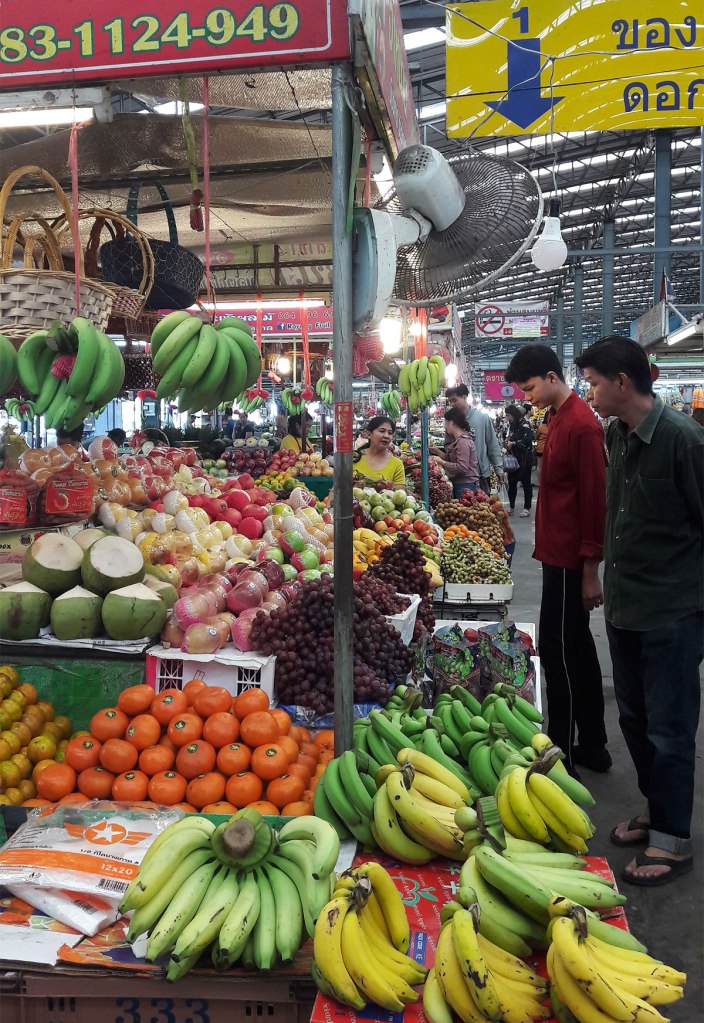
It’s a shame because Thai dishes can be traditionally flavorful and healthy. I certainly understand why foreigners believe the diet is a good one when you see Thailand’s abundance of produce. But it does come back to the amount of sugar they put in foods you wouldn’t think they would like in salads and smoothies. It adds up.
Or I should say it has been adding up because “obesity in Thailand has been flagged a major issue with 32% of the population identifying as overweight and 9% obese. With reference to 2016 data from the WHO, Thailand has one of the highest incidence of overweight citizens in the South East Asian region, second to only Malaysia.”
The big news in 2019 was the reveal of how much sugar is in bubble tea drinks which is all the rage. With my American sponsored students, I tried to raise awareness of the amount of sugar Thais consume (four times (26 teaspoons) as much as the recommended amount by the World Health Organization (6 spoonfuls), but like most kids, they ignored the news.
I couldn’t help but wonder if 26 teaspoons was an average or a conservative guess because if I haven’t said it enough, sugar is in everything. Just the other day I noticed my fresh cut pineapple came with a packet of sugar, and this is normal. There have been attempts by the government to label low sugar foods with a ‘healthy’ symbol, and even a crackdown on companies who take advantage of Thais love of gambling thereby drinking their way though one sugary drink at a time to see if they’ve got the winning bottle cap.
With the change in Thais’ standard of living has also come the higher consumption of meat (and bigger portions). This has been personally illustrated in a couple of ways. First, upon returning to Thailand from over two years in Cambodia, I noticed how much more food was given to me. Prices had gone up from 30 baht to 40 for a standard plate of food, but so had the amount of meats and portions in general.
Secondly, as I have recently switched to a plant-based diet/vegan diet, my boss was considerate enough to pre-order vegetarian fried rice for our recent Thanksgiving buffet with the scholarship students. (I didn’t ask and I wasn’t expecting any special treatment.) But what was delivered was shrimp fried rice. Even though I said, it’s okay, what ended up happening was a series of questions regarding what happened to our original order.
Soon we discovered that one of our office gals thought the order was a joke. Our boss then shared how his Thai wife will veto vegetarian options in lieu of adding some meat as well. The idea being that meat makes the dish seem less ‘poor’, as in, we can afford to meat! We had a good laugh over it, but the conversation revealed what Asian countries like Thailand and China are doing to their health.

And then there’s China…
A quick internet search uncovers China’s growing demand for meat. Consider this from The Economist, “Around the globe, China’s growing hunger for red meat, specifically, has seen its beef imports grow 40-fold between 2010 and 2018. Obesity, type-2 diabetes and high blood pressure are taking a growing toll. To curb such afflictions, guidelines issued in 2016 urge adults to eat just 40-75 grammes of meat a day, or about half the current national average.”
Actually, the news is overwhelming and worth the segue because of China’s influence, not only this part of the world, but across the globe. Quartz claims that China’s biggest health problem is high blood pressure (the silent killer), and just like Thailand, this is due to their growing middle class and consumption of processed Western foods.
Bloomburg published a comprehensive chart of the leading causes of “years of life lost” and a diabetes map of China if you’re interested in a more visual assessment of the top health problems plaguing the country.

It’s not just them, it’s us, too
Thailand and China’s health crises are also the world’s health problems. From the WHO’s 2019 global threat report, “ Noncommunicable diseases, such as diabetes, cancer and heart disease, are collectively responsible for over 70% of all deaths worldwide, or 41 million people. This includes 15 million people dying prematurely, aged between 30 and 69.”
Seriously. Read that again.
It seems humanity likes to learn by mistakes, and making copious amounts of them. We don’t seem particularly good at planning either. It’s hard to believe that we’re at the very beginning of a new decade, 2020, and diet related diseases are killing off 70% of the world’s population. I still can’t believe that we found our 49 year old friend dead of a stroke in his apartment.
We’re stubborn creatures, determined to ignore what’s best for us for what feels good at the moment. We’re also overwhelmed, so we do nothing instead. But the crazy thing is we are in control of our diet and exercise, and these seemingly small things have a long and lasting impact.
How has your diet changed for yourself, or in your community?









 Life, the Universe, and Lani
Leave a reply to Su Leslie Cancel reply