As a fresh profusion of tourists arrive to Thailand I feel both sorry and sympathetic. When travellers visited Oahu Hawaii, where I grew up, I often heard, “We thought it would be less, you know – developed.” Yeah, everyone expects more island. Here, I would imagine visitors would expect more Thailand.
You know how they say marijuana is the gateway drug to all other hardcore drugs? (Not that I believe in this.) Well, I’ve decided Thailand is like the gateway drug to other (hardcore) travel destinations. And that’s why everyone likes it. It’s a smooth feeling without going too far out.
Look, I just don’t like it when I hear a red truck songtaew driver try to charge 300 baht to a tourist, when a typical ride around town cost 20 baht. You might think, hey, that’s not your problem. Well, it kind of is. I live here, and my friends live here, and when we try to get around, the mafia drivers think they can fleece us too. Even in pasa Thai, the Thai language. It’s an interconnected, tightly woven world, folks.
That being said, everyone expects a certain kind of experience, but the rapid development that is sweeping here and there, is bringing down not only the level of expectations folks have of the “exotic” but the uniqueness that made here or there what it is. Chiang Mai isn’t the only city changing for the sake of modernization.
This phenomenon was happening back in the United States, when I lived there. I watched Walmart take over my hometown Mililani, and as I drove down the coast of Southern California, on my way to San Diego, the red tiled roofs of strip malls seem to make each city blend seamlessly into the next. But the biggest trend that brought me down was the same ‘ol same ‘ol restaurant chains from West to East that made me feel that choice (and good food) was no longer an option.
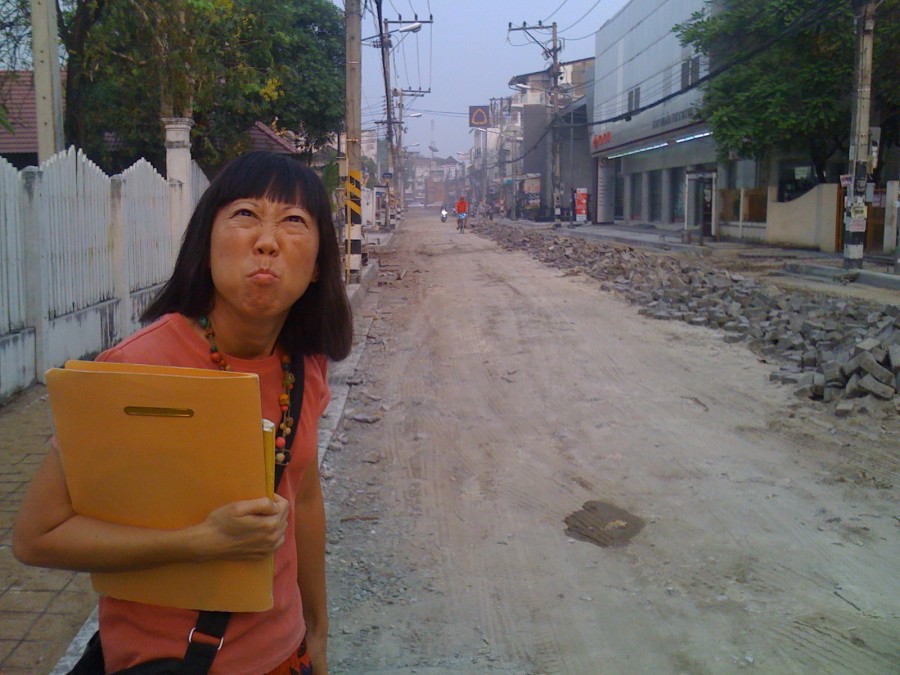
Not too long ago, the city of Chiang Mai decided to rip up the cobblestone/brick roads inside the Old City. Some of these original streets or sois still remain, but the main vein, Ratchadamnern Road that cuts through Tha Phae Gate, went from quaint to utilitarian.
Since I work on Ratchadamnern, I frequent the area, and for a while I couldn’t understand why it was so bloody hot whenever I walked there, but a friend astutely pointed out that it was the new pavement. She was right, and I was surprised by how much it made a temperature difference.
By now I’ve gotten used to it, as I have to, the McDonalds, Burger King and Starbucks that surround Tha Phae Gate, the centro de la ciudad or “center” of the city.
I’ve also gotten used to the massive amounts of ongoing construction, the malls and buildings that don’t finish because someone ran out of money, the condominiums that stand empty waiting for buyers, and the increased traffic. Oh, lord, has the traffic gotten so much worst. And the ugly graffiti – and trash.
When I was interviewing at a school, back in the States, I asked the teachers, “What’s the school’s biggest challenge?” And one of my future colleagues chirped up, “We’re growing so fast!”
At the time, I thought, Great! That doesn’t seem to be a big problem at all! How wonderful! Of course, now I realize just what a Big Mac Whopper of a problem that is.
As we increasingly spin towards a mono-culture of globalization, how will this change the way we experience travel? Do we do the Jimmy Nelson thing and go to the remotest areas in search of “lost” “forgotten” “stuck in time” tribes for questionable reasons, or do we look for the extraordinary in the ordinary? Will the ordinary be good enough?
Perhaps my sympathy for first time travellers to Chiang Mai is also mixed with easy envy, as they take in the sights and sounds with fresh eyes open to whatever adventure lies awake.
I don’t know. Maybe cities don’t lose their specialness in the wake of development but instead, find in their development, what makes them special. Let’s hope so.








Comments create conversations. Let’s talk.